To prevent and respond to homelessness in our community, the City of Bellevue provides access to shelter and housing and services to support housing stability. The city also implements fair enforcement of city code that promotes the safety and wellbeing of all Bellevue community members. We also support regional efforts to prevent homelessness and to make it rare, brief and one-time when it occurs.
Do you need help?
Individuals and families in need can seek help at Shelters and Safe Parking and Food Assistance. You can also contact Bellevue's homelessness outreach program manager Nicolas Quijano (425-452-4105 or nquijano@bellevuewa.gov) or consult Bellevue's homelessness services guide.
Addressing Homelessness
Nationwide, studies have shown that lack of affordable housing is a primary cause of homelessness. Individuals and families experiencing homelessness may also have additional barriers to stable housing including low-paying jobs, domestic violence, chronic health problems, substance abuse or mental health issues.
To prevent homelessness if possible and, when it does occur, return individuals to stable housing with supportive services as soon as possible, the city:
- implements an affordable housing strategy
- funds nonprofit organizations serving people experiencing homelessness
- supports shelters
- funds subsidized housing and related supportive services
- employs outreach staff to connect people experiencing homelessness to housing and services
- works in partnership with neighboring communities and regional agencies
- implements supportive services including a safe parking program
To track our progress, we have a housing and services data dashboard.
Eastgate Housing Campus
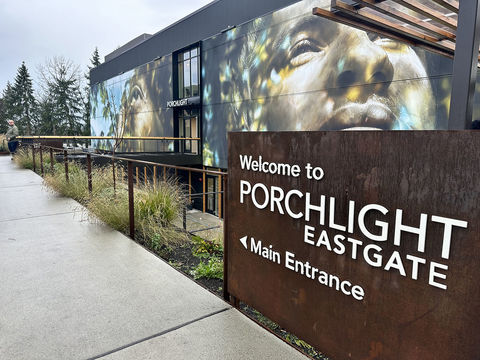
The City Council 2021-2023 Priorities directed the city to “work toward an Eastside solution for a permanent location for a men’s winter homeless shelter.” This vision, with support from community members, businesses, service providers and government partners, has resulted in the Eastgate Housing Campus. The permanent site includes three separate organizations: the 100-bed PorchLight men’s shelter (project background), 92 units of permanent supportive housing at Plymouth Crossing, and 300 units of affordable workforce apartments at the Polaris Eastgate.
- To contact staff at PorchLight, call 425-289-4044. For volunteer opportunities, email volunteer@porchlightcares.org
- To contact staff at Plymouth Crossing, call 206-210-0450. For volunteer opportunities, email volunteer@plymouthhousing.org
- To contact staff at Polaris Eastgate, please call 425-537-7482
Permanent Supportive Housing Frequently Asked Questions
The City of Bellevue is engaged in multiple efforts to provide resources and support to those in need of permanent supportive housing and experiencing homelessness and working to ensure the success of these services within the community.
Here are answers to some frequently asked questions about permanent supportive housing – including the Plymouth Crossing permanent supportive housing building in Eastgate, which provides 92 studio apartments to formerly homeless adults.
What is Permanent Supportive Housing?
Permanent supportive housing (PSH) is a proven, cost-effective and compassionate housing model used to help people out of homelessness. “Permanent” means that there is no time limit for the housing. “Supportive,” means that the building offers on-site services, telehealth, and connections to local service providers that help residents thrive.
What services are available on site at a PSH facility?
Permanent supportive housing is designed to support people living with complex and disabling health conditions. In addition to housing, permanent supportive facilities provide residents with access to a range of on- and off-site services designed to help them recover from experiencing homelessness and ultimately achieve housing stability. Services include 24/7 staffing, case management, community activities, counseling, health care and additional programs.
How are the services at PHS facilities funded?
Plymouth Crossing’s capital (construction) funding was provided by Washington State Housing Finance Commission Tax Credits, the WA Department of Commerce Housing Trust Fund, King County, and A Regional Coalition for Housing (ARCH).
Plymouth Crossing’s operational funders include King County Housing Authority through project-based vouchers, the City of Bellevue’s Housing Stability Program, King County’s Department of Community and Human Services and the Washington Department of Commerce Permanent Supportive Housing Operating, Maintenance, and Services program.
How do residents come to Plymouth Crossing?
Many residents are connected through the county-wide referral system called Coordinated Entry. Plymouth Crossing also partners with local agencies, including the City of Bellevue, to refer individuals directly from the community. A key role of on-site case managers and community specialists is to help residents stay connected to services within the community in which they’ve most recently resided. For Plymouth Crossing, a concerted effort is made to receive referrals from Porchlight Men’s Shelter, The Sophia Way and as many other Eastside partners as possible, including the City of Bellevue’s Homelessness Outreach Program. As a result, many Plymouth Crossing residents have strong connections to the Eastside and are able to stay within their community.
What kind of background check is required for Plymouth Crossing residents?
Plymouth Crossing follows the same guidelines for subsidized housing eligibility as the King County Housing Authority. Specifically, resident income must be less than 30% of the area median income (AMI), which was $27,200 in 2025 for a single adult. Most residents receive social security income, which is typically under $10,000 annually – less than half of the required 30% AMI threshold.
In addition, Plymouth Crossing residents must be single adults who are exiting from experiencing homelessness and be either 55 or older or have a disability. To live at Plymouth Crossing, residents must be U.S. citizens and have a social security number. They must also pass criminal background, credit and rental history checks.
How does permanent supportive housing differ from shelters, adult family homes, skilled nursing facilities and other types of housing?
When a new resident moves into Plymouth Crossing, they must sign a lease and become a tenant. Unlike homelessness shelters and other transitional housing programs, residents of Plymouth Crossing can stay in their home permanently. They are expected to be able to live independently Plymouth Crossing offers opportunities for residents to engage in additional health and supportive services, but they are not required.
What are some of the expectations that come with signing a Plymouth Crossing lease?
Residents moving into Plymouth Crossing agree to several building rules, such as honoring specific quiet hours and not possessing weapons on-site. Residents use guest sign-in and sign-out systems to ensure that on-site staff are aware of who is on the property. Residents are expected to keep up their apartments; Plymouth staff does monthly health and safety inspections in each unit.
How does Plymouth Crossing address onsite drug use to ensure the safety of residents and the community at large?
Treating substance use disorder while living on the streets can be extremely challenging. For many Plymouth Crossing residents, having a place to call home is the first step to their recovery. Once housed, residents develop relationships with onsite case managers and behavioral health providers to evaluate and address their substance use issues. Plymouth Crossing strives to meet people where they are, with individualized treatment. This effective approach is backed by decades of research.
How is “Housing First” different from a safe injection site or halfway house?
Housing First provides stable housing without requiring sobriety. Housing is never used as a reward or punishment. It’s the starting point. Moreover, not all PSH residents are using substances or have a diagnosable substance use disorder.
Plymouth Crossing practices harm reduction, an evidence-based approach that focuses on reducing harm associated with substance use. Harm reduction has been scientifically proven to increase the likelihood that an individual will initiate substance use disorder treatment, versus forcing treatment upon someone who is not ready.
Unlike safe injection sites – which are not permitted in Bellevue – Plymouth Crossing does not supervise drug use. Unlike halfway houses, abstinence is not a condition for staying housed. Residents have daily access to case managers and a full range of support services.
What is the eviction process for the tenants at Plymouth Crossing?
Plymouth Crossing leases include standard building rules — quiet hours, respectful use of shared spaces, timely rent, and guest and anti-harassment policies — like in market-rate housing. When violations occur, staff work closely with tenants to address issues through support services such as rent assistance, housekeeping help, social skill-building, and referrals to community partners. Plymouth staff care deeply for each of their residents and are committed to working with them to preserve their housing, which is why they continually outreach and offer options.
Eviction decisions consider the severity of a tenant’s behavior and the tenant’s response to support. If someone poses a safety risk or needs care beyond what Plymouth can provide, they pursue alternate housing or eviction in service of community well-being.
How does Plymouth Crossing ensure residents and visitors remain safe?
Plymouth staff play a key role in maintaining safety. Front desk staff are onsite 24/7, while case managers and community specialists build supportive relationships with tenants. Safety ambassadors provide extra support after hours, and tenant support aides assist with in-unit safety needs like decluttering and sanitation.
All staff are trained in trauma-informed care and certified in de-escalation. The goal is to help residents stabilize and get their needs met. In addition, Plymouth Crossing staff and the Bellevue Police Department and CCAT and CARES programs maintain strong and collaborative working relationships.
How do you ensure the safety of areas surrounding the Plymouth Crossing building?
Plymouth’s building rules are legally enforceable through the lease, including a strict no-weapons policy (even in vehicles), quiet hours, and property respect. The building maintains a robust guest policy to monitor access and can enforce bans or trespasses when necessary. Security cameras cover all common areas, elevators, hallways, and the building’s exterior.
Safety protocols are continually evolving, tested, and developed in collaboration with professionals. Plymouth prioritizes community safety—not just for their residents, but for their neighbors. They actively foster communication and problem-solving and work closely with the City of Bellevue and the Bellevue Police Department to support neighborhood safety and create a secure environment for all.
What happens if a resident is convicted of a crime while they are living at Plymouth Crossing?
Plymouth adheres to all local laws and expects residents to follow them as well. They approach individual incidents on a case-by-case basis. The priority is keeping all our residents safe and housed.
What can the Bellevue community do to support the Plymouth Crossing project?
To stay updated with Plymouth Crossing, follow them on social media (Instagram, Facebook, LinkedIn, YouTube) or subscribe to their newsletter at plymouthhousing.org. For further questions, please consider attending their monthly Eastside Office Hours on the second Wednesday of each month, 11 a.m.-1 p.m., at the Together Center in Redmond.
There are also volunteer opportunities at Plymouth Crossing. For more information on volunteering, visit plymouthhousing.org/how-you-can-help/volunteer/.
Housing Stability Program
The city dedicates a portion of sales tax revenue authorized by House Bill 1590 (2020) to affordable and supportive housing and programs through its Housing Stability Program. The program allows nonprofit and community organizations offering behavioral health services, housing and employment services to Bellevue residents to apply for funding.
Health Through Housing
King County, through its Health Through Housing initiative, is working to create 1,600 units of permanent supportive housing (featuring 24/7 staffing that offers case management, employment counseling and medical/behavioral health services).
While Bellevue is not participating in this program, the county has purchased former hotels in neighboring Redmond and Kirkland, as well as other cities, and is converting them into housing with on-site services to provide people experiencing chronic homelessness a permanent place to live. For additional information, visit Health Through Housing or email health.through.housing@kingcounty.gov.
Reporting Encampments
If you see an individual in need of support or are concerned about a potential unauthorized encampment, please send us a note via the MyBellevue portal or on your phone via the MyBellevue app. Details about the city's response are available at Encampments, Living in Vehicles.
If you are a private property owner and someone is camping on your property, our how-to sheet offers guidance.
Legal Limits on Enforcement
The courts have issued rulings that affect how governments regulate their public property when it’s being used by those experiencing homelessness. Tent encampments or vehicle residences may be a person’s primary dwelling, so are treated with a similar privacy interest as one’s home.
The law provides for some protections and due process before the government may intrude on one’s home or seize personal property. For example, if a local government plans to clear an encampment, it must provide notice to the camp resident unless there is an urgent situation such as camp occupants posing a risk of immediate physical harm to others or blocking a sidewalk or access point.
Further, the courts have ruled that criminal and civil enforcement of anti-camping ordinances against individuals experiencing homelessness violates the Eighth Amendment of the U.S. Constitution (cruel and unusual punishment) if no alternatives to sleeping in public are available. In other words, it is unconstitutional to punish simply sleeping somewhere in public if one has nowhere else to do so. Also, if an unhoused individual must sleep outside, cities cannot prohibit them from taking “rudimentary precautions” or necessary minimal measures to keep themselves warm and dry from the elements of weather.
This information is not comprehensive and should not be interpreted as legal advice. It is provided to show the legal principles involved in regulating public property. Additional information about how the city responds to vehicle or tent encampments is available at Encampments, Living in Vehicles.