
This information should not be construed as legal advice. Keep in mind that laws change frequently and vary by jurisdiction.
Let’s say you come home one evening to find your neighbor digging up your laurel hedge, the one that you’ve been pruning for the last 8 years. Your neighbor says it’s on his property. Since when? Or perhaps your concerns developed over time. Maybe the garage your other neighbor built a few years ago looks like it is partly on your property. The garage isn’t bothering you, but you are worried about the long-term implications to your title.
Property boundary disputes are challenging in three main ways:
- Saying “It’s mine” and proving it are two very different things
- In practical terms, you may both own it
- Other authorities may be involved.
“It’s Mine!” Like most homeowners, you probably have a deep belief that you control the environment within your property boundaries. If that belief is violated or undermined you probably feel angry, panicked, or scared. You can’t stop yourself from feeling these emotions, but you can control how you express them. Even if you’re really upset, yelling and or threats are not in your interest. Such a response is likely to make your neighbor more committed to their position, unwilling to negotiate, and ready to start an all-out feud.
It is not a good idea to ignore the situation either. Property boundary disputes have a nasty way of getting worse when you need to refinance, remodel, or sell your house. Better to deal with it when you don’t have that additional pressure.
In some cases, neighbors can pay for a survey to decide where the boundary is and resolve the dispute. However, it is not always this simple. When a property owner has occupied the land of his neighbor for ten years or longer, they may have a legal claim to that land through “adverse possession,” regardless of what a survey indicates.
However, when it comes to adverse possession, claiming it and proving it are two different things. For example, a simple written letter from one neighbor to the other granting permission to use the land on the other side of the fence may be enough to defeat an adverse possession claim. Buyers and title companies don’t want to trust an assertion of adverse possession. They want proof in the form of a deed or a court order. Trials are often more expensive than the value of the disputed strip. These cases are usually complicated and require the help and advice of a real estate attorney.
“It’s Ours!” If, after researching the value of the land and the cost of litigation, you decide that a trial is more time and expense than you want to face, what comes next? Without a court decision, both you and your neighbor have claims to the disputed strip of land. Legally, you are not co-owners. But, in practical terms, you might as well be. Your challenge is then to either decide on a way to divide the property or decide on a way to share it. These negotiations can feel like tug-of-war games. The more one of you gets, the less the other gets.
Consider this example: The Wong and the Martinez families are in a property boundary dispute. Figure A shows the disputed strip between their properties. It turns out that the Martinez family does a lot of gardening, and they have an interest in expanding their backyard. The Wong family has just purchased a new RV, and their driveway is too small for it, so they have an interest in expanding their front yard. If the neighbors are willing to discuss their interests, they can negotiate a new property line as shown in Figure B.
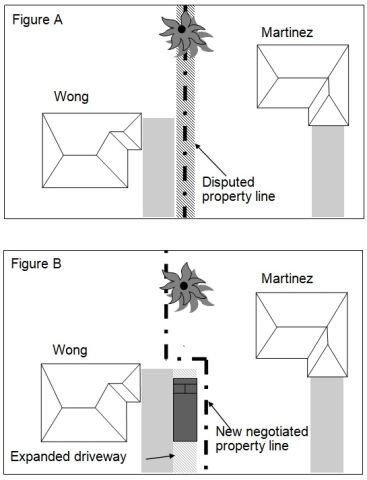
Not all disputes have such neat win/win solutions, and compromise is required. But it would be a shame to miss out on the best solution for both you and your neighbor because you are locked in a win/lose battle over where the line is and never get around to talking about underlying interests.
“Who Else Cares?” Alas, creating a valid new legal boundary is not simply a matter of getting Wong and Martinez to both say, “I Do.” Others must say “We Do too.” The tax assessor may re-value the land based on new property line agreements. Mortgage lenders have deeds of trust tied to the recorded lot size. Local governments have rules about how close a house can be to a property line. Will the new property line leave one neighbor with an undersized lot that the city deems to be “unbuildable?” If the parcel is large, is giving up the Disputed Strip going to cost one neighbor the ability to subdivide?
If you decide that you want to negotiate with your neighbor, but aren’t sure how to start the conversation, call the Bellevue Conflict Resolution Center. We can coach you on how to talk with your neighbor, or we can talk to your neighbor for you to learn more about what is important to them and what solutions they might be willing to consider.